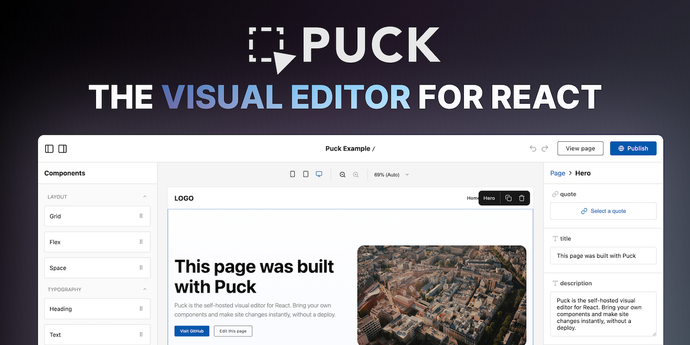
Puck is a React component for building drag-and-drop editors with your own components. Its modular model leaves the application in control of data and composition rules.
Tech watch
← All linksPage 3 of 4
Puck is a React component for building drag-and-drop editors with your own components. Its modular model leaves the application in control of data and composition rules.
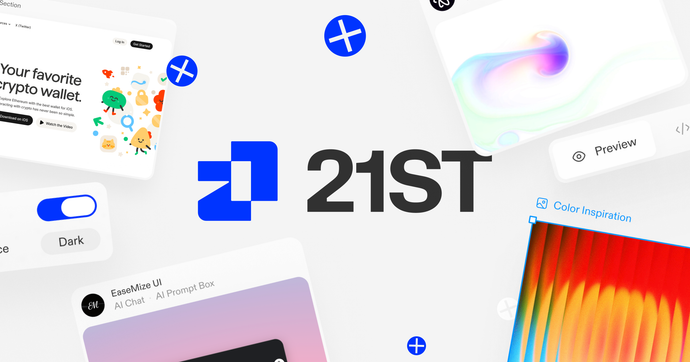
21st collects interface components and blocks, including hero sections, cards and animated backgrounds. The catalogue supports comparing visual directions and finding a starting point to customize.

The former Origin UI address now leads to coss ui and its component catalogue. Accordions, dialogs, fields and calendars provide shared building blocks for interfaces.

PDFSlick provides PDF viewer examples for React, Svelte, SolidJS and JavaScript. Navigation, thumbnails and zoom show how documents can become part of the application interface.
Gabriel Pichot organizes loading, error, success and empty states with pattern matching. The approach reduces scattered branches in components and improves readability.
This library derives LLM tools from React hooks. Human and agent interfaces can share the same state, with a developer-defined schema controlling state changes.

Robin Wieruch builds a Next.js chat connected to the OpenAI API, from the server route to the interface. The tutorial adds streaming to display responses progressively.
Robin Wieruch

Omlet shows component usage and supplied prop values inside VS Code. These insights help teams understand actual library adoption before changing components.
This repository collects React component libraries and design systems with animation capabilities. It provides a starting point for comparing their approaches and demos.

This catalogue presents applications, components, frameworks and tools built around React. Categories make it easier to find examples and libraries to investigate.
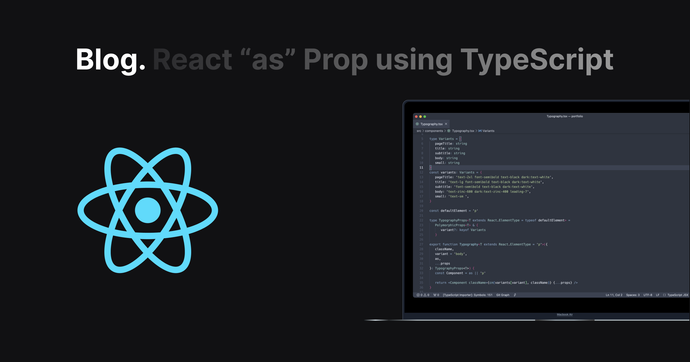
This tutorial builds an as prop that changes the rendered HTML element while preserving valid property types. TypeScript generics help prevent attributes from leaking between different tags.
This collection provides animated interface components to copy and customize. Demos cover text effects and transitions for enhancing existing interactions.
React Bits collects backgrounds, text effects and interactive components installed as source code. Exposed parameters let developers tune motion and appearance for their project.
David Haz
Normy normalizes data fetched through libraries such as React Query or SWR. Shared entities can then update across cached results without repeating synchronization logic.
The component animates movement and rotation using sine waves. Amplitude, speed and time offsets let you tune the effect and desynchronize multiple elements.
Daniel Petho

The official plugin provides React lint rules and a recommended ESLint configuration. Its documentation covers setup and options for experimental compiler rules.
React Scan highlights components worth inspecting for performance problems. Script and package integrations support an initial diagnosis without rewriting application components.

Aurora Scharff uses URL parameters as the source of truth for filtering, sorting and pagination. The article covers coordinating that state with interactions and Server Components.
Aurora Scharff
A click shortcut on a component opens its source file in the editor. A context menu also exposes parent components and props to help locate the relevant code.

Nuqs offers a useState-like API with typed parsers and history controls. It makes filters shareable and reloadable by keeping their state in the URL.
François Best