Sébastien Rigaux

Tech watch

← All links

Animation

Motion in interfaces: transitions, gestures, timing and reduced-motion preferences.

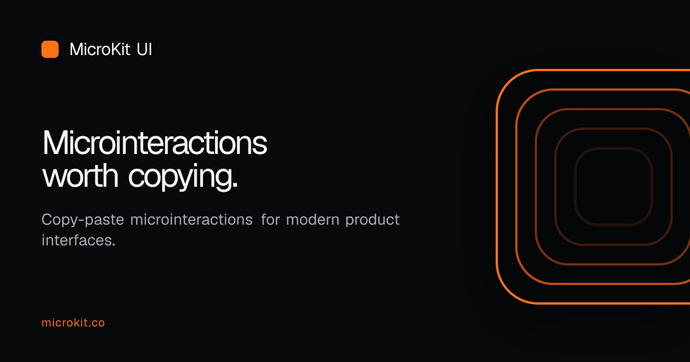
MicroKit UI graphic on a black background, showing the text “Microinteractions worth copying” beside concentric orange rounded squares.

MicroKit collects copy-ready interactions—animated buttons, tabs, inputs and hover effects—with React or CSS and Tailwind variants. Each component is copied separately in JavaScript or TypeScript, with no package to install; 26 of the 54 have no dependencies, while 28 use lucide-react.

The code is MIT-licensed, and Tailwind variants are designed for versions 3 and 4. In the Next.js App Router, most components work in server components; those using state, refs or event handlers need « use client ».

Henrique BaroneFound via Frontend Focus

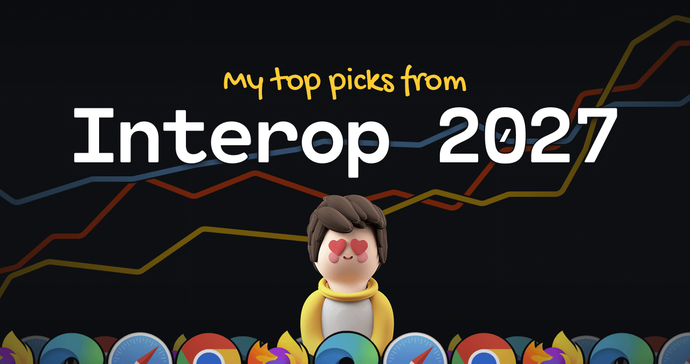
Image reading “My top picks from Interop 2027,” with a character at the center, in front of colored curves and browser icons.

Josh W. Comeau reviews ten proposals being considered for Interop 2027: CSS functions, custom border shapes, anchor- and scroll-related queries, reading order, intrinsic-size animations, and grid decorations. Several address practical problems: reading-flow could align keyboard navigation with a responsive layout, while grid decorations could draw separators without adding empty DOM cells.

The proposals are at different stages of maturity. As of October 2026, several are available in Chromium but not yet in Firefox or Safari; inherit() is implemented in no browser. The article shows where progressive enhancement is feasible, with safeguards such as @supports for height transitions.

Josh W. Comeau

Header for the article “Embracing Playful Imperfection With The CSS random() Function,” by Brecht De Ruyte, with a red Smashing Magazine cat illustration.

The CSS random() function adds visual variation in the browser, without JavaScript or Sass loops. Brecht De Ruyte demonstrates it with subtly tilted letters, cards animated on scroll, and shadows that respond to card rotation. A caching key can keep multiple properties in sync, while sibling-index() calculates the structure of a fanned-out card stack.

These effects are best suited to decorative elements: the article advises against randomizing grids, body text, or interactive targets. With browser support still rolling out, it recommends a stable baseline enhanced through @supports, and stresses respecting prefers-reduced-motion and screen-reader access.

https://www.smashingmagazine.com/author/brecht-de-ruyte/Found via Frontend Focus

React Bits banner on a purple background, reading “React Components That Stand Out” and “200+ Free Creative Components”.

React Bits 2.0 announces 216 animated components: 104 have been rebuilt or redesigned, and more than 20 have dropped extra dependencies. Demos add presets and click interactions, while Background Studio, Shape Magic, and Texture Lab have been rebuilt to tune effects live and export the results.

The update also refreshes the documentation and landing page, which is reported to use about five times less JavaScript. The catalog supports expressive interface prototyping; the range of animations still makes it worth assessing their runtime and dependency costs before integrating them into a product.

David HazFound via JavaScript Weekly

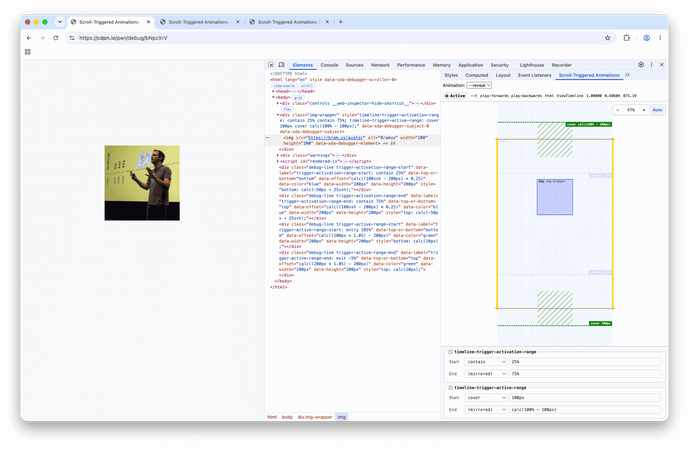
Screenshot of Chrome DevTools showing the extension panel, its minimap, activation and active ranges, and their editing fields.

This Chrome DevTools extension makes CSS animations triggered by scrolling easier to debug: a minimap locates the scroller, element, and subject, while colored markers show activation and active ranges. Values can be edited live; the tool supports ScrollTimeline, ViewTimeline, and elements using position: sticky.

Two limitations come from Chrome: relative units such as 90vh are reduced to computed pixel values, and elements inside an iframe are not supported. The extension fills a gap in DevTools while built-in support remains a possible future improvement.

@bramusFound via Frontend Focus
Sheet component illustration and highlights from React Aria v1.22.0 release

React Aria v1.22.0 introduces the Sheet component, a swipeable overlay leveraging native browser scroll gestures for smooth, touch-friendly transitions—well suited for mobile trays and notifications. This release also brings Turbopack support for locale optimization, improved handling of interactive widgets like the virtual keyboard, and various fixes for collections, ComboBox, and forms.

Adobe

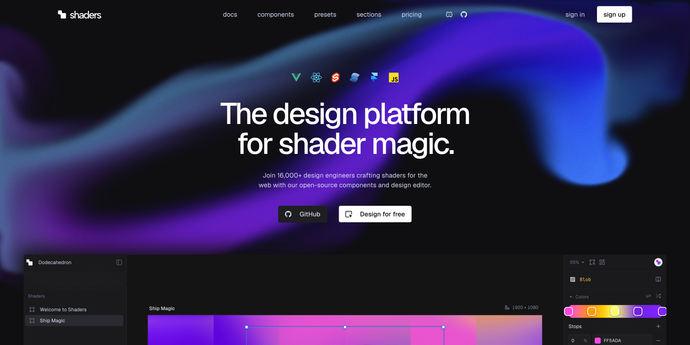
Shaders components documentation illustration: WebGPU effects for React, Vue, Svelte, Solid and JavaScript.

This documentation lists over 190 ready-to-use visual components for integrating WebGPU effects into React, Vue, Svelte, Solid, and plain JavaScript. The components span a wide range: textures, shapes, materials, filters, distortions, transitions, blurs, adjustments, and interactive effects, each with a concrete description of its rendering and parameters. A resource to quickly enrich an interface with advanced visual effects without writing low-level shaders.

Shaders