Sébastien Rigaux

Tech watch

Page 6 of 22

Tool

Refero Styles: AI-ready design system library

styles.refero.designPermalink
Preview of the Refero Styles website style library

Refero Styles offers a browsable collection of over 2,000 design systems from well-known product sites, each paired with a DESIGN.md file readable by AIs like Cursor, Claude, or ChatGPT. The tool lets you inspect colors, typography, spacing, and components, then reuse these styles in your own projects or AI prompts. It’s a practical resource to give visual context to an assistant or speed up interface design inspired by market references.

Refero

Supahero offers a curated collection of website hero sections showcasing diverse and visually engaging header designs. Each entry highlights different styles, animations, and layouts, making it a practical resource for interface inspiration or design research. While advanced filters are missing, the fast browsing experience lets users quickly explore a wide range of real-world examples.

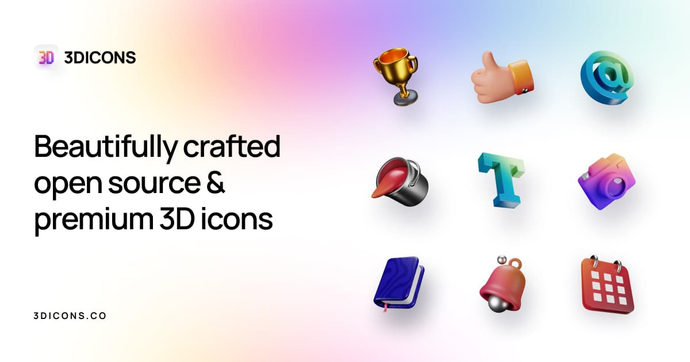
Preview of the 3dicons.co 3D icon collection

3dicons.co offers over 1,400 open-source 3D icons, free to use without attribution for personal or commercial projects. The platform lets you customize color, angle, and download icons individually or in bulk, with themed collections and Figma integration. Its CC0 license makes it easy to incorporate these assets into any application or design system.

realvjy

TanStack Start 1.0 stable release poster

TanStack Start 1.0 marks the official stable release of a full-stack framework, already proven in production, that blends SPA-style routing, server rendering, streaming, and typed server functions for React and Solid. Its focus on end-to-end type safety—from route params to loaders and server functions—makes maintenance and evolution easier, even for AI agents. React Server Components are opt-in, and deployment is flexible via Vite, Nitro, or Rsbuild, without enforcing a single architecture.

Tanner Linsley

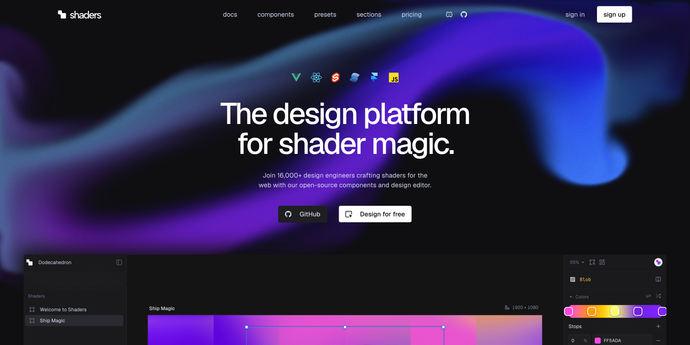
Shaders components documentation illustration: WebGPU effects for React, Vue, Svelte, Solid and JavaScript.

This documentation lists over 190 ready-to-use visual components for integrating WebGPU effects into React, Vue, Svelte, Solid, and plain JavaScript. The components span a wide range: textures, shapes, materials, filters, distortions, transitions, blurs, adjustments, and interactive effects, each with a concrete description of its rendering and parameters. A resource to quickly enrich an interface with advanced visual effects without writing low-level shaders.

Shaders

Void Cloudflare Blog illustration — deploying full-stack Vite apps with Void

Cloudflare introduces Void, an open-source platform combining an SDK, CLI, and hosting environment to deploy full-stack Vite applications on Cloudflare. This unified workflow manages server routes, databases, authentication, and Cloudflare provisioning without manual setup, with a CLI that automates deployment and resource management. The approach aims to speed up prototyping and internal app creation while maintaining access control and security, and integrates with major modern JavaScript frameworks.

Christoph Nakazawa and Michael Dong

TanStack Charts 1.0 article illustration

TanStack Charts 1.0 introduces a composable approach to charting, inspired by the Grammar of Graphics, with a framework-agnostic core and a React adapter. The post explains how each chart element (line, point, bar) is a reusable component, making it easy to extend or customize visualizations as requirements evolve. The stable API and granular imports help integrate charts into scalable applications without sacrificing bundle size or type safety.

Tanner Linsley

Illustration for the certificates.dev article on React browser() API

React Canary introduces the browser() API to render a component exclusively in the browser, avoiding hydration mismatches and extra mounted-state logic. The article demonstrates how to use use(browser()) inside a client component, wrapped in Suspense, to defer rendering until browser APIs are available. Several concrete examples show how this approach enables access to localStorage, the DOM, or user-specific data, without the usual workarounds like useEffect or environment checks.

Aurora Scharff

Next.js 16.4 announcement illustration with Next.js logo on dark background

Next.js 16.4 makes Cache Components the recommended approach, now enabled by default for new projects created with create-next-app. This model lets you declare cache behavior at the component level, with APIs to control static or dynamic rendering and fine-tune prefetching. The release also brings agent tooling for migration, Turbopack optimizations (cache size, HMR, smaller bundles), support for React 19.3, and several experimental features for build and development.

Next.js Team

DocumentationFR

How to add an RSS feed to an Astro site with @astrojs/rss

docs.astro.buildPermalink
Add an RSS feed – Astro documentation

This guide explains how to quickly add an RSS feed to an Astro site using the official @astrojs/rss module. It covers installation, configuration, and integration for blogs and content sites, including automatic item generation, full content inclusion, link handling, adding a stylesheet, and enabling automatic discovery. Perfect for letting your readers easily subscribe to your posts via their RSS reader.

Docs

DocumentationFR

Major updates in .NET 11: runtime, libraries and SDK

learn.microsoft.comPermalink
Logo .NET 11

This official Microsoft Learn page provides a comprehensive overview of what’s new in .NET 11, currently in release candidate. It details changes in the runtime (performance, native Async, JIT, WebAssembly), libraries (numeric APIs, compression, System.Text.Json, security, LINQ, etc.), SDK (CLI tools, testing, containers, OpenTelemetry), and C# 15 language features. Developers will find a summary of the main improvements, links to updates for ASP.NET Core, EF Core, Windows Forms and WPF, as well as key release dates. Ideal for planning migrations or exploring the new capabilities of the .NET platform.

gewarren

Vinext 1.0 announcement illustration from Cloudflare Blog

Cloudflare releases Vinext 1.0, a Vite-based reimplementation of Next.js that claims over 99% compatibility with the official test suite (excluding Cache Components). Vinext supports both App and Pages Router, offers a two-command migration path, and introduces cache warming handled on the Cloudflare network to optimize page pre-generation. The project relies on extensive automation to track Next.js changes and maintain compatibility, while making distinct choices for ISR and cache management.

James Anderson and Matt “TK” Taylor

Open-source React blocks for building admin apps

Shadcn Admin Kit provides open-source blocks for building internal tools, dashboards, and B2B apps with React. It preconfigures data tables, forms, authentication, search, and internationalization, with advanced capabilities such as generated CRUD screens, permissions, bulk actions, and undo.