Sébastien Rigaux

Tech watch

Page 3 of 22

Black graphic with the text “Ship less JavaScript in Next.js with your AI agent” and the Next.js logo.

Next.js 16.4 includes an AI agent skill that analyzes Turbopack’s module and chunk graph to find imports that add to shipped JavaScript. It can, for example, spot when a static import elsewhere in the bundle prevents a component from staying deferred, then suggest changes for review before applying them.

The analyzer also compares snapshots and filters code loaded on the initial render. Vercel reports nearly two megabytes of compressed JavaScript saved across v0 and vercel.com; the fixes were checked on preview deployments. The tool requires Turbopack, the default bundler since Next.js 16.

Will Binns-SmithFound via This week in React

Illustrated map of mountains, valleys, and dotted paths connecting different points.

TanStack DB reaches 1.0 RC1 after extensive stabilization work. Kyle Mathews explains how test oracles—independent models that calculate expected behavior—and property-based testing uncovered bugs in collection updates and the change messages sent to subscribers.

These executable references also give coding agents precise rules to preserve when changing the implementation. The trade-off is clear: writing and refining models takes work, but their simplicity makes complex algorithms easier to verify. The RC also supports incremental adoption, from existing REST APIs to local persistence, offline mutations, and real-time sync.

Kyle MathewsFound via This week in React

Visual for the Vinext 1.4 post, showing its title, a summary of the changes, and the October 28, 2026 date.

Vinext 1.4 reduces work across several rendering stages: App Router layouts run once per request, prefetching dynamic routes no longer renders the entire page, and the chunks needed for hydration can compile in the background in recent Chrome. On the Hacker News benchmark, the author reports 31.1 ms of CPU per request, versus 54.4 ms in 1.3 and 33.7 ms for Next.js.

The release also keeps cached HTML and RSC payload generation in sync. Results still depend on the workload: on a content-site prototype, Next.js paints sooner and uses less CPU per request. A TanStack Redact test shows another trade-off: less JavaScript to download, but substantially more expensive hydration on content-heavy pages.

James AndersonFound via This week in React
TanStack AI 1.0 graphic with TanStack logos, the text “AI building blocks for TypeScript,” and a palm tree against a gradient background.

TanStack AI 1.0 stabilizes its core APIs for combining chat, tools, media, and integrations across multiple providers and UI frameworks. Tree-shakable adapters and end-to-end tests using deterministic fixtures check the flows without live model calls.

The agent harness adds durable sessions, interrupts, and background work, but remains 0.x and may change in minor releases. Upgrading requires moving the stable packages together and supplying a threadId explicitly; passing the type check does not migrate persisted conversations or files.

co-authored by Alem Tuzlak, Jack Herrington, Tom Beckenham, and Tanner LinsleyFound via This week in React

TanStack Redact graphic reading “Your React app. Less JavaScript.” with logos for TanStack Start, Vite, Vinext, and Next.js.

TanStack Redact 0.2.0 replaces React and React DOM in the browser without changing application code. Its stable integrations support TanStack Start, Vite, Vinext, and Next.js; with the latter two, React still handles server rendering while Redact takes over hydration and client rendering.

TanStack’s measurements show bundle reductions from 20.4% to 70.5% across its reference apps, but actual savings vary by project. The tradeoff is explicit: Redact renders synchronously, without React’s time slicing or interruptible rendering. A heavy render can therefore delay input, so compatibility and the busiest screens should be checked in each application.

Tanner LinsleyFound via This week in React
OpnForm logo on a light background, with the tagline “The open-source form builder”.

OpnForm is an open-source form builder available as both a managed cloud service and a self-hosted application. Its repository documents practical operational details: bundle-size limits, PostgreSQL index migrations that keep writes available, isolated Docker environments for worktrees, and dependency security checks. It also provides an MCP server that lets AI agents create and preview drafts, with versioned previews that support restoring earlier revisions.

OpnForm

GitHub preview of the shader-effects-inc/shaders repository, described as a WebGPU component library for React, Vue, Svelte, Solid, JavaScript, and Framer.

Tanner Linsley’s AI-driven React projection experiment has become a TanStack project used in production. Redact is a smaller, React-compatible runtime that already works with Start, Next.js, Vinext, and Vite. On the server, React still handles SSR and Server Components.

The tradeoff is in rendering: Redact renders synchronously, without React’s time slicing. As the blog post acknowledges, a heavy render can still delay input. The smaller runtime therefore comes with a constraint worth considering for interfaces that need to remain responsive under load.

Shader Effects, Inc.Found via This week in React
WebCheck banner with the project name in green, the text “On-demand OSINT tool for exploring website data,” and a globe icon protected by a shield.

WebCheck brings publicly exposed domain information into one interface: DNS, TLS certificates, HTTP headers, subdomains, detected technologies, and potential threat-list matches. It offers 44 checks and can also examine redirects, trackers, and email configuration.

The results provide a useful starting point for surface-level checks, not a substitute for a thorough audit: some data, such as vulnerabilities linked by Shodan, depends on external sources. The project is open source, can be self-hosted, and provides an API.

Alicia Sykes

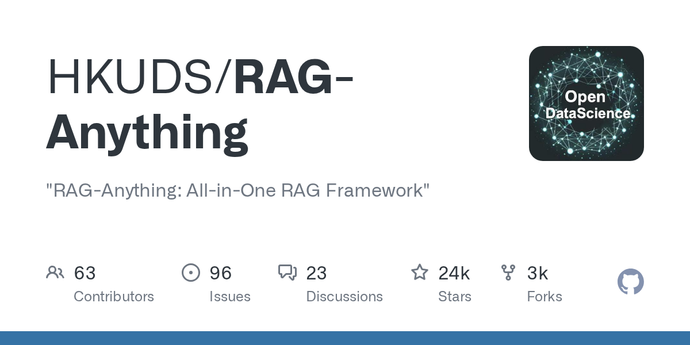
GitHub preview of the HKUDS/RAG-Anything repository, showing the Open DataScience logo and contributor, issue, discussion, star, and fork counts.

RAG-Anything is a framework built on LightRAG for indexing and querying documents that mix text, images, tables, equations, and charts. It coordinates parsing and content analysis in a single multimodal pipeline.

The project combines vector similarity with a knowledge graph, provides processors for different content types, and can pass retrieved images to a vision model during queries. A recent change also routes rendered charts through the image pipeline while preserving captions and extracted text. To update a previously indexed document, multimodal reprocessing must be explicitly enabled with force_multimodal_reprocess=True.

HKUDS

MicroKit UI graphic on a black background, showing the text “Microinteractions worth copying” beside concentric orange rounded squares.

MicroKit collects copy-ready interactions—animated buttons, tabs, inputs and hover effects—with React or CSS and Tailwind variants. Each component is copied separately in JavaScript or TypeScript, with no package to install; 26 of the 54 have no dependencies, while 28 use lucide-react.

The code is MIT-licensed, and Tailwind variants are designed for versions 3 and 4. In the Next.js App Router, most components work in server components; those using state, refs or event handlers need « use client ».

Henrique BaroneFound via Frontend Focus

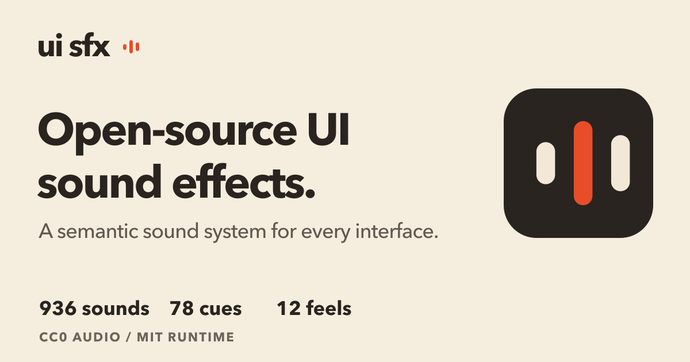
UI SFX graphic showing an open interface sound library with 936 sounds, 78 cues, and 12 sonic styles.

UI SFX groups 78 interface events into 12 sonic styles, so teams can compare how the same feedback feels without changing what it means. The library includes 72 one-shots and six loops, with interactive previews that place sounds in product flows.

Install it with npm install uisfx; its TypeScript API plays sounds and lets callers stop a loop when the associated state ends. Audio files use the CC0 license, while the runtime is MIT-licensed—a clear split that supports reuse in web and native projects alike.

Yuki Capital

Screenshot of The Website Specification, headed “What a good website does,” with four areas: the document, the experience, trust and discovery.

This specification brings together 178 topics covering a website’s technical responsibilities, including HTML, accessibility, security, performance, SEO, privacy and resilience. Each topic explains why it matters and how to implement it, with items marked as required, recommended, optional or to avoid.

A yes/no checklist turns those criteria into an audit that teams can revisit after fixes. Grounded in primary sources and platform-agnostic, the specification is also available to agents through a read-only MCP server, with no authentication required for its reference tools.

@jdevalk

The W3C has launched a second pilot in its open-source program: a polyfill for WebMCP, an incubating JavaScript API that lets applications expose functions as tools callable by agents and assistive technologies. The polyfill is intended to support experimentation and interoperability as the specification evolves.

Plans include publishing an npm package, tracking Web Platform Tests coverage, and advancing lifecycle events and declarative support. If WebMCP moves onto the standards track and interoperable native implementations emerge, the polyfill would be phased out gradually.

Ian Jacobs, Strategy Team

An illustration shows a dilapidated web code tag connected by digital streams to an iPhone struck by a red and blue distortion.

Expired domains behind old analytics and advertising tags have been bought and repurposed to redirect visitors to malicious content, including the Coruna and DarkSword iOS exploit kits. Report URI and iVerify describe a chain that filters visitors and tailors its payload to the device; security scanners may receive only an empty response.

The case shows how a forgotten third-party script remains an active dependency: its domain can change hands without any site change. The article recommends auditing tags, monitoring loaded scripts, and restricting their domains with a Content Security Policy.

Scott Helme

WebSub defines a notification protocol between publishers and subscribers: a subscriber discovers a hub, registers a callback URL, and receives updates from the hub over HTTP. The specification covers subscription validation, renewal, and delivery retries, while leaving the mechanism publishers use to notify hubs unspecified.

The updated W3C Recommendation adds safeguards against XSS attacks during subscription verification. It also specifies HMAC signatures for notifications: SHA-1 remains common for compatibility, the document notes, but recommends at least SHA-256 when TLS transport may be compromised.

GitHub-generated preview image for the w3c/activitypub repository.

The W3C repository presents ActivityPub, a decentralized social networking protocol that combines a client-to-server API with a federated server-to-server API. Built on the ActivityStreams 2.0 JSON-LD format, it supports extensible activity descriptions and different kinds of social applications.

The repository also explains how to evolve a published recommendation: clarifications belong in the Primer, corrections follow an errata process, and breaking changes require a new working group. That formal governance reflects the deployment cost of changing a protocol used by many independently operated servers.

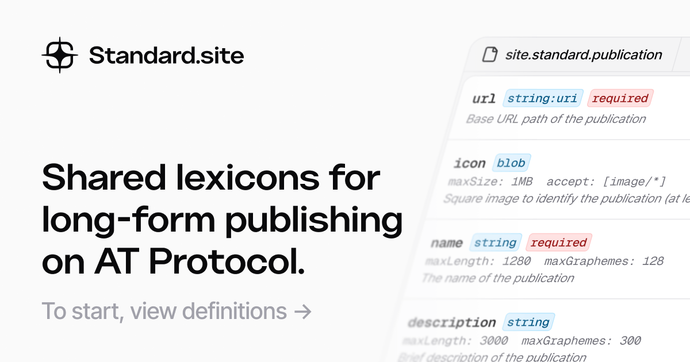
Standard.site graphic presenting shared lexicons for publishing on AT Protocol, with part of a publication schema visible.

Standard.site proposes shared lexicons for publishing platforms on AT Protocol. The goal is to give indexers and tools a common schema while making content easier to discover and move between hosts.

The standard describes metadata for publications, documents, and subscriptions without prescribing a content format. Each platform can choose which lexicons to implement. Verification uses a /.well-known/site.standard.publication route to link a domain to its publication, and an HTML tag to associate a document with its AT-URI.

White banner with the black text “Next Themes” and GitHub and sponsor icons.

next-themes applies the theme as the page loads, respects the system preference, and syncs the choice across tabs. Its ThemeProvider works with both the App Router and pages/, while a hook lets components switch themes or handle multiple variants.

One architectural detail matters: the browser-stored theme is unavailable during server rendering. UI that depends on useTheme should wait until the client component mounts to avoid hydration errors. The library also updates the <html> attribute—suppressHydrationWarning is recommended—and remains independent of the CSS solution in use.

Promotional illustration for the makeplane/plane GitHub repository.

Plane brings work-item tracking, cycles, modules, pages, and analytics together in an open-source project management platform, with self-hosting options through Docker or Kubernetes. Its repository also documents a substantial architecture effort: migrating the interface to the Propel design system in stages, with tests, accessibility checks, and the gradual removal of legacy components. The web app uses React and React Router, with Django on the API side.

Plane

GitHub preview card for the rlaope/oh-my-hermes repository, showing the project name, tagline, and counts for contributors, issues, stars, and forks.

oh-my-hermes adds an orchestration layer to Hermes Agent: it maps work categories to models and reasoning effort, loads skills on demand, and can turn a goal into a graph of parallel tasks. Each task keeps a separate write scope, while a distinct node verifies the outcome.

A notable architectural choice is separating preparation from execution evidence: a plan is not treated as completed work, and an agent’s claim that it finished does not validate the result. The project also offers review-gated memory and a dedicated TUI, without replacing or patching Hermes Agent.

rlaope